


2015 was the hardest year to make money in 78 years
Markets It’s been a really, really tough year for returns.
According to data from Societe Generale, the best-performing asset class of 2015 has been stocks, whose meager 2 percent total return (that is, including dividends) still surpasses those of long-term bonds, short-term Treasury bills and commodities. These minimal gains make 2015 the worst year for finding returns since 1937,
Read the entire article: 2015 was the hardest year to make money in 78 years
2015 was the hardest year to make money in 78 years Read Post »

The riskiest stock to own? Your employer’s
Financial Planning, Retirement Shortly before Enron collapsed, 62% of employees’ 401(k) assets were invested in Enron. Above, Playboy magazine’s “Women of Enron.” Pension plan consultants, in the wake of a recent Supreme Court case, are telling retirement plan sponsors to reconsider their decision to offer company stock in a 401(k) plan.
You might want to do the very same: Revisit your decision to invest in your company’s stock in your employer-sponsored retirement plan.
Consider: “Defined-contribution plan participants frequently allocate too much of their total retirement portfolio to company stock,” Mark Teborek, a senior consulting analyst with Russell Investments in Chicago, wrote in a recent paper, “Revisiting Company Stock in Defined-contribution Plans.”
In fact, company stock represents on average a whopping 22.5% of defined-contribution assets among plans with more than 5,000 participants, according to the Plan Sponsor Council of America’s 57th Annual Survey, 2014.And that sort of outsize position in company stock might be considered […]
Click here to read the full article: The riskiest stock to own? Your employer’s
The riskiest stock to own? Your employer’s Read Post »

What retirement crisis? It’s all good
Retirement Almost 70% of women said spending time with their grandchildren was a top retirement goal. Worried about your lack of retirement savings? Take solace from this: A majority of those who are already in retirement say it’s not as financially stressful as you may think, according to a new survey.
Fully 79% of retirees at all income levels said it’s easier than they thought to manage their savings in retirement and to “adapt their lifestyle based on their finances, if necessary,” according to a new survey of 12,000 preretirees and retirees aged 55 to 80, at all income levels (all are participants in a defined-contribution plan), conducted by Greenwald & Associates Inc. for Fidelity Investments, in collaboration with the Stanford Center on Longevity.
That’s not all. A whopping 85% of the retirees surveyed said retirement has been the most rewarding time of their lives — and that sentiment held up […]
Click here to read the full article: What retirement crisis? It’s all good
What retirement crisis? It’s all good Read Post »

Average Americans May Never Retire, But That’s Okay
Lifestyle, Retirement Most people don’t set out to be average but at some point a new study or poll may lump them into that category. Unfortunately, for those classified as “average,” it is becoming increasingly difficult to feel secure about their potential to ever retire in the traditional sense.
Recently the Social Security Administration disclosed that the average American took home roughly $44,500 in net compensation. While that’s a 3.5% increase from 2013, when combined with other American averages, such as having less than $60,000 saved for retirement and predictions of spending upwards of $245,000 on healthcare during retirement, it’s easy to see why people are leery about reaching their golden years.
Some quick calculations confirm what many people are worried about. Using the Social Security Administration’s Quick Calculator Tool, the average American baby boomer age 62 and claiming benefits in 2015 would receive approximately $982 per month (less than $12,000 per year). […]
Click here to read the full article: Average Americans May Never Retire, But That’s Okay
Average Americans May Never Retire, But That’s Okay Read Post »

Opinion: 7 ways to catch up if you’re behind on retirement savings
Financial Planning, Retirement Most financial advisers agree: The simplest way to ensure you retire comfortably is to start saving early and let the power of compound interest work for you over time.
But what happens if you’re getting a late start on retirement, or financial troubles in middle age ate into your nest egg and now you’re playing catch-up?
The hard reality is that the vast majority of Americans get a late start on retirement planning. Consider a 2011 study from the Schwartz Center for Economic Policy Analysis at The New School, which found a staggering 68% of Americans age 25-64 weren’t even participating in an employer-sponsored retirement plan like a 401(k).
More recently, a 2014 survey from finance website Bankrate.com found more than one-third of Americans don’t have a penny saved for retirement, including more than a quarter of those age 50 to 64.It’s also important to point out that many Americans grossly underestimate […]
Opinion: 7 ways to catch up if you’re behind on retirement savings Read Post »

Reading Your Employee Handbook Can Pay Off In A Big Way Before Retirement
Financial Planning, Retirement There are a myriad of things that people must consider before they retire. They contemplate whether they will have enough money or not; if they’ll out live those fund; and whether they have their savings allocated correctly to name a few.
But many people don’t think about flipping through their employee handbook before retirement and as a result may be leaving unclaimed time and money on the table.
I was recently talking to a family member at an event and learned he was retiring. After congratulating him, I asked when the big day was and what led to him making the decision.
He was very specific, including both a date and time.“January 31, at 4pm” he said.“Okay, you’ve really got the date and time nailed down don’t you,” I replied… adding, “Any significance to the 4pm?”He laughed, “Yes I was going to retire at the end of the year but after I […]
Reading Your Employee Handbook Can Pay Off In A Big Way Before Retirement Read Post »

The Cheapest Days To Fly And 12 More Holiday Travel Tips
Travel Complaints about stressful holiday travel are as old as St. Nick himself. Armed with these tips, you’ll be able to pack some holiday cheer (plus unwrapped presents) while en route to grandma’s.
1. Pick the right day to fly.
Busy airports, crazy-high fares, winter weather delays — are you sure you want to do this? The busiest (and most expensive) travel days of the year are around the holidays. You’ll save a lot of stress and a small stocking of cash by picking the right days to fly. We also have handy fare calendars to show you the cheapest day to fly on 1000 popular routes.
2. Rise and shine.
Don’t want to miss the carving of the turkey or the unwrapping of presents? Book the earliest flight you can. Sure, you’ve got to wake up early, but those first flights out are the least […]
Click here to read the full article: The Cheapest Days To Fly And 12 More Holiday Travel Tips
The Cheapest Days To Fly And 12 More Holiday Travel Tips Read Post »

10 Dirty Little Secrets of Hotels
Travel On average hotels do a much better job of satisfying customers than airlines—a conclusion supported by many surveys and ranking systems. But beating the airlines is a pretty low bar: No modern hotel accommodations are as downright uncomfortable and unpleasant as an economy class airline seat.
Even so, however, many hotels and hotel chains harbor some dirty little secrets they’d prefer to keep under wraps. Some are endemic while others are isolated. Here are a few to you’ll be glad to know.
Mandatory Fees
Mandatory “resort,” “concierge,” “housekeeping,” “porterage,” fees (along with other more esoteric varieties) are the hotel industry’s most active and widespread current scam. Hotel perpetrators slice off a part of the real price, post the remaining low-ball partial price as the basic room rate, give a plausible label to the sliced-off part, and add it back in before you buy. The practice started in Las Vegas and […]
Click here to read the full article: 10 Dirty Little Secrets of Hotels
10 Dirty Little Secrets of Hotels Read Post »

Why Inflation Is Lower Than You Think
Financial Planning, MarketsFinancial pundits routinely claim that inflation is much higher than the reported statistics. We hear, for example, that food prices have risen much faster than the roughly 1.5% increase in the consumer price index (CPI) over the past several years. Viewed over the longer term, however, inflation is far lower than reflected in the published data.
The reason for this anomaly is that the CPI doesn’t reflect the rapid advances in technology and the new products and services that have benefited everyone.
The implications are profound. For example, real GDP growth is greater than has been reported, and some claims of income inequality are misleading.
This theme was the focus of two recent presentations I attended. On October 18, the economist Woody Brock hosted a private gathering of investment professionals from Australia and New Zealand, organized by the Portfolio Construction Forum , at his home in Gloucester, Massachusetts. On October 22, Rick […]
Click here to read the full article: Why Inflation Is Lower Than You Think
Why Inflation Is Lower Than You Think Read Post »

Life lessons from a life-affirming heart attack
Health & Fitness, Lifestyle, Retirement You can’t judge the real impact of a life-changing event until you’ve lived some life afterwards. Only then can you take stock and measure the size of and commitment to the change.
Five years ago last week, I suffered a heart attack, caused when a building clot broke free, floated downstream until it got stuck, and created a 100% blockage in the artery known by cardiologists as “the widowmaker.”
The changes I expected in the immediate aftermath and a year after the event are, in some respects, different from the reality I live with today. (Read the column I wrote upon first returning to work) , and the column I wrote a year later.)
But life itself is a series of life-altering events. For example, a divorce completed early this year — after 30 years of marriage — was every bit as unexpected as the heart attack; it just wasn’t as […]
Click here to view original web page at Life lessons from a life-affirming heart attack
Life lessons from a life-affirming heart attack Read Post »

Boomers In Retirement: The Greatest Giving Generation?
Retirement Watch with money One retirement study after another trumpets the boomers’ lack of saving for retirement and their need to work longer than previous generations. (Wells Fargo today said the median savings of working Americans 60 or older is $50,000.) Call these the “Me Generation” retirement reports.
But what will boomers do for others during retirement? Will they become the Thee Generation?
Maybe so. A fascinating new study from Merrill Lynch and the Age Wave research firm ( Giving in Retirement: America’s Longevity Bonus ) predicts that boomer retirees potentially will give the equivalent of $8 trillion through charitable donations and volunteering over the next two decades. The longevity bonus is the demographers’ term for the population’s increased life expectancy.
If they’re right — and I have some qualms about the precise dollar estimate, which I’ll explain shortly — this will make boomers the greatest giving generation in U.S. history. What the […]
Click here to view original web page at Boomers In Retirement: The Greatest Giving Generation?
Boomers In Retirement: The Greatest Giving Generation? Read Post »
Uncertainty Overrides Our Common Sense
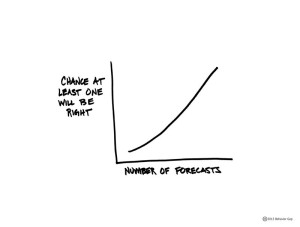
Behavioral Finance, Financial PlanningThe desire we have for certainty and to make order out of chaos causes us to overlook the reality that life is uncertain. I understand why we do it. The uncertainty is scary, but it’s impossible to get forecasts about the future 100 percent right. What happens when we […]
Uncertainty Overrides Our Common Sense Read Post »
Andrea Coombes’ Ways and Means: Your grandchildren will save more for retirement than you
Financial Planning, Retirement Young adults in the U.S. may be getting the message that saving for retirement is on their shoulders — they’re starting to put aside money for retirement years earlier than previous generations. That’s the good news. But when it comes to retirement saving in the U.S., there’s still plenty to worry about, too.
On the good-news front, Generation Y (currently ages 18 to 34) started saving for retirement at age 23, on average, according to a new survey of 1,000 U.S. investors, conducted by CoreData Research for Natixis Global Asset Management.
That’s six years earlier than Gen X (currently ages 35 to 50), who started saving at age 29 on average, and 10 years earlier than the boomer generation (currently ages 51 to 69), who started saving at age 33, according to the survey.
Where will technology be 30 years from now?
(2:09)
The CEOs of Google Ventures and XPRIZE share their predictions for the state of technology 30 years from now.
“That is a significant difference,” said Ed Farrington, executive vice president of retirement at Natixis Global Asset Management. “Time is one of the great allies when it comes to an investment plan. If you start earlier, you have to save a whole lot less and you wind up with a whole lot more — that’s the power of compounding.”
Their smarter savings strategy may be a result of Gen Y, also known as millennials, growing up at a time when the traditional pension was already all but dead, Farrington said. “They perhaps never heard of the promises of a defined-benefit plan or pension,” he said. “They’ve grown up in a world where … they have to put money away for themselves. This is not foreign to them.”
But savers aren’t confident, don’t know how much they need
That said, there is still plenty of uncertainty among retirement savers of all ages. Only 50% of the survey respondents said they’re confident in their investing knowledge and abilities — and their fears appear well-founded. When asked how much money they could safely withdraw each year from a $1 million portfolio that needed to last for 30 years, 60% said 8% or more was a safe withdrawal rate. The safe withdrawal rate rule of thumb is closer to 4%. Read Is the 4% withdrawal rate right for you?.
Meanwhile, 47% of the survey respondents said they’re not sure how much money they need to save for retirement, and 54% of the survey respondents said they don’t believe their savings will provide enough retirement income. Read How much should you save for retirement?
When asked to pin down how much they need to save for retirement, Gen Yers said they need to save about $769,000, on average, and Gen Xers said $741,000. Boomers said they would need $946,000. Read Why you might be saving too much for retirement.
Getting savers on track
The survey also found that employers hold at least one key to improving the state of retirement savings in the U.S.: the power of the match.
Fully 74% of survey respondents cited their company’s 401(k) (or other defined-contribution plan) match as the reason for participating in their company-sponsored retirement plans.
And 50% of those have access to a workplace plan but don’t participate in it cited the lack of a match or said the match was too small, according to the survey.
“The plan sponsor has to make the plan as robust as possible, and then it’s up to the individual to participate, to understand it and to maximize it,” Farrington said, “so that when they get to that point in time [i.e., retirement] they’re prepared.”
Source: Andrea Coombes’ Ways and Means: Your grandchildren will save more for retirement than you

How Thinking About Retirement Shapes Your Life
Financial Planning, Retirement
 Many people dream about what they would do all day if they didn’t have to go to work. The key is to dwell on retirement in such a way that it starts to shape your finances. Here’s how my retirement goals have shaped my saving and spending patterns.
I want to be financially secure in retirement, so every dollar I save is the best dollar I will ever spend. I highly value freedom. Saving enough to retire will mean I’m no longer working because I need the cash to survive. I envision a future where I can choose to work only when the endeavor excites me. Whenever I find ways to reduce my spending, I’m really just diverting that money toward a future use.
I want to retire sooner, so I make an effort to increase my income. Working hard throughout your career is a given. But don’t forget about other ways to bump up y…
Read the entire article: How Thinking About Retirement Shapes Your Life
How Thinking About Retirement Shapes Your Life Read Post »